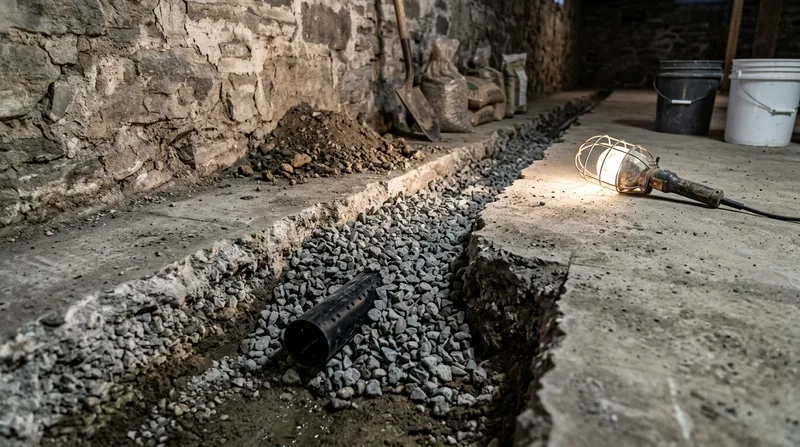




Interior Drain Tile System in Utica: Cut the Water Off at the Footing
If your basement floor stays damp from March through May, or you see a bead of water along the cove where the wall meets the slab after a hard rain, you are looking at hydrostatic pressure from the Mohawk valley floor. Utica sits on glacial lake clay and silt that holds water like a sponge, and it rests on Utica shale bedrock that gives that water nowhere to go but up and sideways. The Interior Drain Tile System in Utica is the answer we install most often for that exact condition: we cut the slab edge, dig down to the footing, lay perforated pipe in washed stone, and lead the water to a sump basin that pumps it out and away. It is the one method that works on hand-dug 1890s stone foundations in Cornhill and on poured 1990s full basements out in Marcy, and we can install it in any season. If you are still weighing options, start with our basement waterproofing overview before you commit to a method.
Why Interior Drain Tile Matters in Utica's Clay and Shale
The failure mode here is not a single cracked wall. It is a water table that climbs every spring as snowmelt soaks into the clay and the Mohawk River runs high, pushing water against the footing from below. That water finds the cove joint, the porous block cores, and the mortar joints in old stone walls. Deep frost and freeze-thaw cycles work the foundation every winter, opening the same seams a little wider each year.
- We see water entering at the wall-floor joint in Cornhill and Harbor Point two-family homes with stone foundations dug by hand in the 1890s.
- We see block walls in New Hartford and Whitesboro Cape Cods wicking moisture up past the efflorescence line because there is no footing drain to relieve the pressure.
- We see finished lower levels in Yorkville and Oriskany split-levels ruined by a sump pump that quit during a summer storm.
- We see poured full basements in the outer-town subdivisions take on water because the original drain tile clogged with silt after 20 years.
In every one of those cases, the water is arriving under the slab, and no amount of sealer on the inside face of the wall will stop it. That is the honest answer, and it is why we lead with drainage rather than a coating.
Key info: A homeowner in Cornhill called us after two summers of mopping. The wall was dry above grade, the grading was fine, and the downspouts ran out to the yard. The water was coming up through the cove joint from the clay. An interior perimeter drain cut the basement dry in two days.
Before you authorize any work, check the permit rules with the City of Utica building department, because work that alters drainage or the sanitary connection of a sump discharge is commonly permitted and the thresholds vary by jurisdiction.
How We Install an Interior Perimeter Drain in a Utica Basement
We do not guess at where the water is coming from. We walk the basement, read the efflorescence pattern, check the cove joint, test the existing sump, and look at the foundation type before we quote a linear footage. Then we work in a fixed sequence so the basement drains the same way in every house we touch.
- We set up plastic containment and a vacuum to keep dust out of the living space above.
- We saw-cut a channel roughly 12 inches wide around the interior perimeter, tight to the wall.
- We dig down to the footing and remove the clay and silt that has packed in over the decades.
- We lay perforated pipe in washed stone with a filter fabric wrap, pitched to the sump.
- We set the sump basin at the low corner, tie in the drain, and install the pump with a check valve.
- We run the discharge line out through the rim and away from the foundation, then pour new concrete over the channel.
Every step is inspected before we close the trench, and we leave the basement swept and the concrete cured before we call the job done.
Key info: In a 1920s foursquare in New Hartford with a partly finished basement, we cut the channel inside the finished wall, kept the paneling intact, and tied the new drain to a sump pit in the utility corner. The homeowner kept the rec room and gained a dry floor.
If your existing tile is crushed or silted shut, see our drain tile repair and replacement page before you assume a full new system is the only option.
Interior Drain Tile Compared to Other Waterproofing Approaches
Not every wet basement needs the same fix, and we tell homeowners plainly when a simpler method will do the job. The table below lays out how the interior system stacks up against the alternatives we install across the Utica metro.
| Approach | Description | Best for |
|---|---|---|
| Interior perimeter drain | Pipe at the footing inside the slab, led to a sump basin and pump | Clay soil and a rising water table, any season |
| Exterior excavation | Dig out the foundation, membrane the wall, replace the footing drain | Bowing walls and severe outside pressure |
| Crack injection | Epoxy or polyurethane injected through ports into a single crack | One isolated non-structural crack, no cove seepage |
| Wall sealing and vapor barrier | Sealer on the wall face plus dimple board to manage moisture | Damp walls and musty smell, no standing water |
When the water is under the slab, the interior drain is the only one of these that actually removes it.
Interior Drain Tile System Cost in Utica: What to Expect
Most interior drain tile work in the Utica area starts around From $50/linear ft, and that figure covers the cut, the excavation, the pipe, the stone, and the concrete patch. From there the number moves with the length of the run, the thickness of the slab, whether the basement is finished, and whether we are tying into an existing sump or setting a new basin. A 40-foot run in an unfinished Yorkville ranch is a different job from a 120-foot perimeter in a finished Cornhill two-family.
We give you a linear-foot number and a written scope, not a vague range. Get two or three estimates and compare the scope line by line, because a low number that skips the stone or the concrete patch is not the same job. Our pricing overview breaks down what each line item means.
Interior Drain Tile System Near Me: How to Vet a Utica Contractor
You are hiring someone to cut your slab and dig at your footing, so the vetting matters more than the sales pitch. Ask for the license and insurance certificate before anyone walks into the basement, and confirm the coverage is current for the crew that will actually be on site. Get at least two written estimates with the same scope so you can compare like for like.
- Ask for local references from jobs in Utica, New Hartford, or Whitesboro and call them.
- Confirm who pulls the permit if drainage or the sump discharge connection is altered.
- Ask what happens if the sump pump fails after installation and whether a battery backup sump pump is part of the plan.
- Get the warranty terms in writing and confirm it is transferable.
If a contractor will not put the scope and the warranty in writing, keep looking. When you are ready, contact us and we will schedule a free basement inspection at (315) 864-5045.
When an Interior Drain Tile System Beats Exterior Excavation
We install both, and we recommend the interior system when the pressure is coming from under the slab and the walls are still straight. Exterior excavation is the right call when a wall is bowing or the pressure is crushing block from the outside, and we say so when we see it. For the typical Utica basement with a wet cove joint and a water table that climbs each spring, the interior drain gets the water out without tearing up the yard, the sidewalk, or the mature plantings around the foundation.
It also works through the winter, which matters in a climate where the ground freezes deep and the spring thaw arrives fast. We can cut and pipe a basement in January while the clay outside is still locked up.
Call (315) 864-5045 for a free inspection and a straight answer on which method your foundation actually needs.
Interior Drain Tile System in Utica: Pricing Guide
| Service | Price | Details |
|---|---|---|
| Interior perimeter drain, standard run | From $50/linear ft | Includes saw cut, excavation to footing, perforated pipe, washed stone, and concrete patch along the run. |
| Interior drain with new sump basin and pump | From $1,800 | Adds basin, pump, check valve, and discharge line routed away from the foundation. |
| Finished basement installation | On estimate | Requires on-site look to plan containment and protect finished walls, flooring, and utilities. |
| Long perimeter or multiple zones | On estimate | Footage, slab thickness, and footing depth drive the number, so we measure before quoting. |
| Travel | Included | In Utica and surrounding areas, no separate call-out or mileage fee. |
| Estimate | Free | Response within 24h at (315) 864-5045, no obligation to book. |
Indicative pricing, the exact cost depends on square footage, finish, and site access. Free personalized estimate within 24h at (315) 864-5045.


