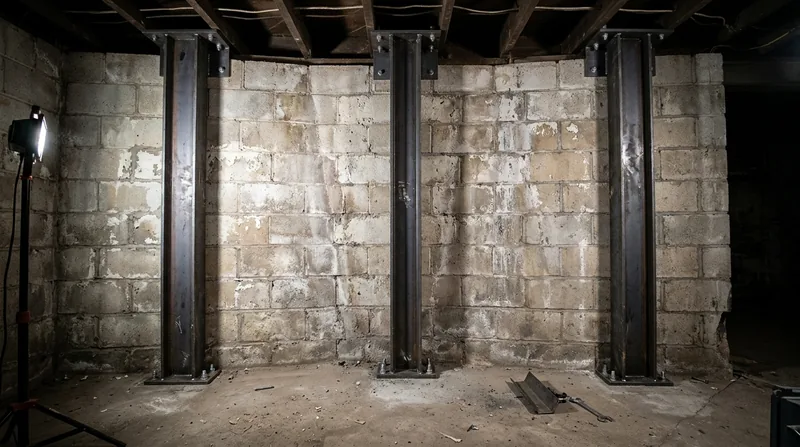




Bowing Wall Repair in Utica starts with understanding what the Mohawk Valley floor does to a foundation. The valley is glacial lake clay and silt sitting on Utica shale, and that clay holds water the way a sponge holds a spill. Spring snowmelt and high water on the Mohawk press against basement walls, deep frost and freeze-thaw cycles work the foundation every winter, and summer storms send fast runoff down the streets toward low corners. In Cornhill, Harbor Point and Bagg's Square, many 1890s to 1920s brick two-families sit on stone or early block walls in basements that were dug by hand, and those walls were never built for the pressure they carry today. We read the wall, the soil and the water before we quote a fix, because a leaning wall in a New Hartford Cape Cod and a bulging wall in a Yorkville ranch rarely need the same answer. Call (315) 864-5045 to set up a free basement inspection and get a straight read on what your wall is doing.
Why Bowing Walls Are Common in Utica's Older Basement Stock
Most of the bowing we see in Utica traces back to hydrostatic pressure and frost, not to bad concrete. The clay and silt around a foundation drain poorly, the water table rises in spring, and the wall takes the load. Older stone and early block walls in Cornhill and Harbor Point were laid with lime mortar that softens over a century of wet cycles, so the wall moves before it cracks. In the outer towns, 1990s to 2020s subdivisions with poured full basements show a different pattern: horizontal cracks near the middle of the wall where backfill pressure and frost push inward.
- Horizontal cracking in the middle third of a block or poured wall usually means soil pressure, not settling.
- Vertical cracks at corners and stair-step cracks in block point to movement that needs straps or anchors, not just injection.
- White efflorescence on the wall face tells you water is moving through the masonry and evaporating inside.
- A wall that leans more than an inch over eight feet is past cosmetic and needs a structural read.
- Doors and windows that stick in one season and free in another signal the wall is still moving.
We tell homeowners plainly when a wall is stable and only seeping, and when the movement is active and needs stabilization before any sealing work makes sense.
Key info: A 1918 brick two-family on a stone wall in Cornhill had a rear wall leaning two inches at the top. The homeowner had already paid for three rounds of interior patching. The wall needed carbon fiber straps and exterior drainage correction, because the clay behind it was holding water against the stone all spring.
For the code side, foundation structural repair in New York is permitted at the local level, and the City of Utica building department is the authority to confirm what your address requires. You can review the city's permit information at City of Utica before work begins.
How We Diagnose and Repair a Bowing Wall in Utica
We start by measuring the movement instead of guessing at it. A plumb line and a level tell us how far the wall has traveled, and a crack map tells us whether it is still moving. Then we look at the water: where the clay is saturated, where the downspouts dump, and whether the footing drain still functions. Only after that do we pick a repair method, because a strap on a wet wall that keeps taking pressure is money spent twice. Our foundation crack repair work often runs alongside stabilization when the wall has both movement and seepage.
- We inspect the full wall from the inside and check the exterior grade and downspout discharge at the same visit.
- We measure the bow with a plumb line and record crack widths so the repair can be matched to the actual movement.
- We stabilize the wall with carbon fiber straps, steel I-beams or wall anchors, depending on severity and soil load.
- We correct the water source with grading, downspout extensions or drainage work so the pressure stops rebuilding.
- We seal remaining cracks and check the repair after the next heavy rain or spring thaw.
If the wall is only seeping and has not moved, we say so and steer you to sealing instead of structural work.
Key info: A 1950s split-level in Yorkville had a block wall with a horizontal crack and a one-inch bow. Wall anchors pulled it back to plumb over two visits, and we extended the downspouts six feet to stop the corner from soaking. The homeowner skipped the exterior excavation entirely because the footing drain was still open.
Where the water is the dominant problem and the wall is sound, an interior drain tile system often solves the seepage at far less cost than digging out a foundation.
Repair Methods We Match to Utica Walls
No single method fits every wall, and the wrong one wastes money. A stone wall in Cornhill behaves differently from a poured wall in a 2005 subdivision off the outer roads, and the soil load differs block by block. Here is how we match the approach to the wall and the ground behind it.
| Approach | Description | Best for |
|---|---|---|
| Carbon fiber straps | Straps epoxied to the wall face and anchored top and bottom to stop further inward movement. | Block walls with horizontal cracking and moderate bowing. |
| Steel I-beams | Vertical beams set against the wall and tied into the floor and joists to hold the wall in place. | Poured walls with deeper movement or heavy clay load. |
| Wall anchors | Anchor plates in the yard tied through the wall to inside plates, with measured pullback. | Walls that have bowed but are not yet cracked through. |
| Epoxy or polyurethane injection | Ports drilled along the crack and resin injected to fill and seal it. | Stable walls with seepage through a single crack. |
| Exterior drainage correction | Grading, downspout extensions and footing drainage work to relieve pressure at the source. | Walls moving because saturated clay keeps loading them. |
We combine methods when the wall has both movement and water, and we tell you which part of the repair is structural and which part is drainage.
Bowing Wall Repair Cost in Utica: What to Expect
Bowing wall repair starts at $600 for a single-crack injection on a stable wall, and that figure is the low end for a reason. Structural stabilization is a different job with a different price, and we would rather give you the real number after we measure the wall than quote a figure that will not hold. The cost moves with the length of wall involved, the repair method, access to the wall, and whether drainage correction is part of the scope. We do not sell structural work to a wall that only needs sealing, and we do not seal a wall that is still moving.
- Wall length and height drive the number of straps, beams or anchors required.
- Method matters: injection for a stable crack costs far less than anchors or beams for an active bow.
- Access to the wall inside the basement affects labor on finished or cluttered spaces.
- Drainage correction, grading and downspout work add scope but stop the pressure from returning.
- Permit requirements vary by jurisdiction, and the local building department confirms what your address needs.
Get two or three written estimates and compare the scope line by line, not just the bottom number. Our full pricing overview shows how the ranges break down before you call.
Bowing Wall Repair Near Me: How to Vet a Contractor Near Utica
When you search for bowing wall repair near me, the results all sound the same. The difference shows up when you ask for proof. Any contractor working on a structural foundation repair should carry current liability insurance and workers' compensation, and should hand you a certificate on request. Ask how long they have worked on stone and block walls in the Mohawk Valley, because the clay and frost here punish a repair that ignores water. Ask for references from jobs in Utica, New Hartford or Whitesboro, and call them.
- Confirm the license and insurance certificate before any work starts, and keep a copy for your records.
- Get two or three written estimates with the scope spelled out, not a single verbal number.
- Ask each contractor how they will address the water source, not just the wall.
- Check whether the local building department requires a permit for your repair, and let the contractor pull it.
- Ask about the warranty terms in writing and whether the warranty transfers if you sell the home.
We put our scope, method and warranty terms in writing before we start, and we answer questions about the wall in plain language. Reach us through the contact page or call (315) 864-5045 to schedule a free inspection.
Bowing Wall Repair in Utica: Pricing Guide
| Service | Price | Details |
|---|---|---|
| Crack injection (stable wall) | Starting at $600 | Epoxy or polyurethane injection on a single stable crack, with ports drilled and sealed |
| Carbon fiber strap stabilization | Starting at $1,800 | Straps epoxied to the wall face and anchored top and bottom, priced per strap and wall length |
| Wall anchor system | Starting at $3,500 | Exterior anchor plates tied through the wall with measured pullback, priced by wall length and access |
| Steel I-beam reinforcement | On estimate | Beams tied into floor and joists for poured walls with deeper movement, needs an on-site look |
| Drainage correction add-on | On estimate | Grading, downspout extensions or footing drainage work scoped after the wall is measured |
| Estimate | Free | On-site inspection and written scope, response within 24h at (315) 864-5045 |
Indicative pricing, the exact cost depends on square footage, finish, and site access. Free personalized estimate within 24h at (315) 864-5045.


