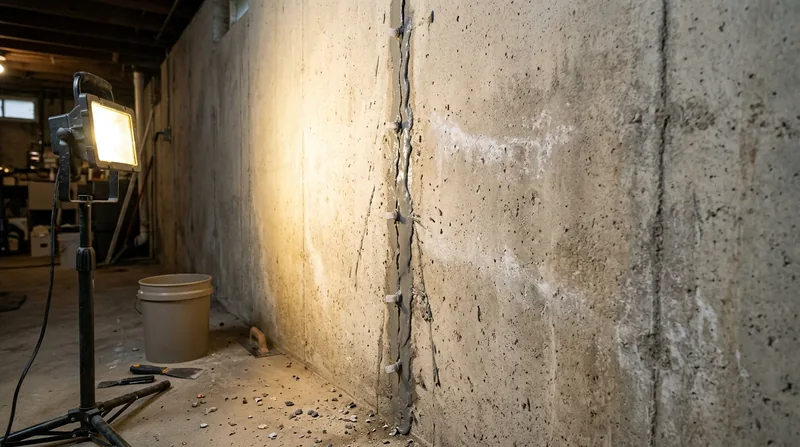




Utica sits on a bed of glacial lake clay and silt that holds water like a sponge, and that clay rests right on top of Utica shale bedrock. When spring snowmelt and Mohawk River high water push the water table up, that trapped water finds every hairline crack in your foundation wall and seeps through. If you own one of the 1890s brick two-families in Cornhill or a 1950s Cape Cod in New Hartford, you already know the routine: a damp stripe on the block after every heavy rain, white powder on the wall, and a basement that smells musty by April. Foundation crack repair in Utica starts with figuring out whether you have a simple shrinkage crack or a wall that is being pushed by hydrostatic pressure. We inspect every crack, match it to the right method, and tell you honestly when sealing is enough and when the wall needs more than a patch. Call Utica Waterproofing at (315) 864-5045 to get a free inspection scheduled.
Why Foundation Cracks Show Up Every Spring in Utica
The Mohawk valley floor traps water in that glacial clay, and the hills around Utica shed meltwater slowly through glacial till. Deep frost and repeated freeze-thaw cycles work on foundations every winter, opening cracks that were tight in October. By March, when the ground thaws and the river runs high, the water table rises and puts steady pressure on basement walls. That is the failure mode that dominates here: hydrostatic pressure against stone, block, and poured walls, not a single isolated crack.
- Hand-dug full basements under Cornhill and Bagg's Square homes put stone and early block walls directly against wet clay.
- Poured and block lower levels in Yorkville and Oriskany split at cold joints and form shrinkage cracks as the frost goes out.
- Older footing drains and weeping tile in 1920s homes are often crushed or clogged, so water sits against the wall instead of draining away.
- Downspouts that dump next to the foundation and grading that slopes back toward the house feed the same cracks all summer.
Each of those conditions calls for a different repair, and sealing a crack without addressing the water behind it just moves the problem to the next joint.
Key info: A hairline vertical crack in a New Hartford bungalow is usually a shrinkage crack that epoxy injection seals for good. A horizontal crack near the frost line or a stair-step crack in a block wall in Ilion is a different animal, and it usually means the wall is moving under soil pressure.
Before any structural work, it helps to know what the City of Utica requires for foundation and drainage alterations, because permit rules vary by jurisdiction and the building department has the final word.
How We Diagnose and Repair a Foundation Crack in Utica
We do not sell a one-size-fits-all patch. Every crack gets inspected for width, direction, movement, and moisture before we pick a method. We check the wall for efflorescence, look at the grading and downspouts outside, and test whether water is actively pushing through or has already dried. That inspection is what separates a $450 injection from a repair that fails again next spring.
- We walk the basement and map every crack, marking width and whether it is vertical, horizontal, or stair-step.
- We check the exterior grade, downspout extensions, and window wells to see where water is entering the soil.
- We clean the crack, drill injection ports at the right spacing, and seal the surface so the resin stays in the wall.
- We remove the ports, finish the surface, and confirm the crack is closed before we leave.
If the inspection shows the wall is bowing or the crack is wide and moving, we shift to structural repair and explain why injection alone will not hold.
Key info: On a 1920s foursquare in Cornhill with a stone foundation, we often find the crack is really a failed mortar joint between stones. We repoint and inject that joint, then recommend an interior drain tile system if water is still coming through the wall base.
Crack Repair Methods We Use in Utica
Matching the method to the crack is the whole job. Here is how the main approaches compare for the foundation types we see across Utica, New Hartford, and Whitesboro.
| Approach | Description | Best for |
|---|---|---|
| Epoxy injection | Structural resin bonds the crack faces back together and restores wall strength. | Non-moving vertical shrinkage cracks in poured walls. |
| Polyurethane injection | Flexible foam expands into wet voids and stops active seepage. | Active leaks in block or poured walls, wet cracks. |
| Parging and surface sealing | Cement parging and a waterproof membrane close porous block faces. | Weeping walls with no single dominant crack. |
| Carbon fiber straps | Straps anchored to the wall resist inward movement from soil pressure. | Bowing block walls with horizontal or stair-step cracks. |
| Wall anchors | Anchors driven into stable soil pull the wall back toward plumb. | Walls that have moved and need to be straightened. |
We choose between these based on what the wall is doing, not on what is easiest to sell, and we tell you when a simpler repair will do the job.
Foundation Crack Repair Cost in Utica: What to Expect
Most single-crack injections in Utica start at $450, and that figure covers a standard vertical crack in a poured or block wall with normal access. The price moves up with crack length, the number of cracks, whether the wall is stone, and whether we have to work around finished basement walls. A structural repair with carbon fiber straps or wall anchors is a different scope and gets priced after an on-site look.
Factors that affect the number include the wall material (stone foundations in Cornhill take longer than poured walls in Oriskany), how many injection ports the crack needs, access to the crack behind insulation or drywall, and whether water is still active. Getting two or three estimates is smart, and it is the fastest way to spot a contractor who is quoting a full waterproofing job when you only need a crack sealed. Our full pricing overview breaks down the ranges by method.
Foundation Crack Repair Near Me: How to Vet a Contractor Near Utica
When you search for foundation crack repair near me, the list of names can look the same. The differences show up in the details: license and insurance status, whether they inspect before they quote, and whether they can explain why one crack needs epoxy and another needs polyurethane. Ask for proof of insurance, call two recent references in the area, and get the scope in writing before anyone drills a port.
- Confirm the contractor is licensed and insured, and ask for a certificate before work starts.
- Get two or three written estimates that name the method, not just a price.
- Check references from homes with the same foundation type as yours.
- Ask who pulls any permit the local building department requires for structural or drainage work.
If a contractor will not put the method and scope in writing, keep looking. You can reach us through the contact page to set up a free inspection and get a straight answer on what your crack actually needs.
Foundation Crack Repair in Utica: Pricing Guide
| Service | Price | Details |
|---|---|---|
| Single crack epoxy injection | Starting at $450 | Standard vertical crack in poured or block wall with normal access and no finish work. |
| Active leak polyurethane injection | Starting at $550 | Wet, seeping crack in block or poured wall; price moves with crack length and port count. |
| Multiple cracks or stone foundation | On estimate | Stone repointing and several cracks need an on-site look before a number is given. |
| Structural repair (straps or anchors) | On estimate | Bowing or moving walls require inspection and a scope based on wall condition. |
| Travel | Included | in Utica and surrounding towns, no separate call-out or mileage fee. |
| Estimate | Free | Response within 24h at (315) 864-5045, no obligation to book. |
Indicative pricing, the exact cost depends on square footage, finish, and site access. Free personalized estimate within 24h at (315) 864-5045.


