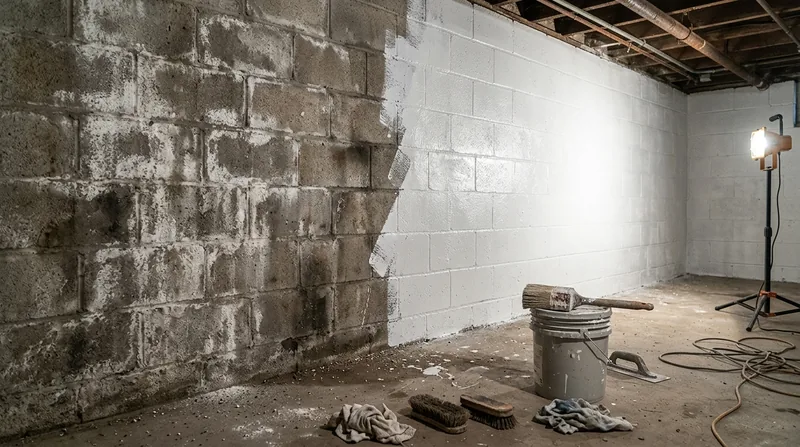




Utica sits on the floor of the Mohawk Valley, where glacial lake clay and silt hold water against stone and early block foundation walls dug by hand in the 1890s and 1920s. In Cornhill, Harbor Point, and Bagg's Square, those old walls sweat, effloresce, and seep every spring when snowmelt and Mohawk River high water push the water table up. Basement Wall Sealing in Utica starts with an honest read of what your wall is actually doing: minor dampness from capillary pull, or active seepage driven by hydrostatic pressure. We prep the surface, strip efflorescence, and apply penetrating or membrane sealers that stop the dampness. If the real problem is pressure, we tell you plainly, because a sealer alone will not hold it. Call (315) 864-5045 or start with a free basement inspection.
Why Basement Wall Sealing Matters in Utica's Old Foundation Stock
The building stock here tells the story. Cornhill and Harbor Point have 1890s to 1920s brick two-families, foursquares, and Victorians with stone or early block walls. New Hartford and Whitesboro have 1920s to 1950s Capes and bungalows with partly finished lower levels. Yorkville and Oriskany have 1950s to 1970s splits and ranches on poured or block walls. Each one fails a little differently, but the driver is the same valley clay that holds water and the shale bedrock underneath that will not let it drain away.
- Spring snowmelt and Mohawk River high water raise the water table and press on the wall from outside.
- Deep frost and freeze-thaw cycles work on the foundation every winter and open hairline cracks.
- Summer storms send fast runoff down the streets toward low corners and window wells.
- Older stone and block walls wick groundwater and push white efflorescence to the surface.
- Poured walls in the outer subdivisions seep at form ties and cold joints after heavy rain.
Sealing the wall face is the right first move when the wall is damp but not running, and the wrong move when water is standing at the cove joint. We tell you which one you have before anyone opens a bucket.
Key info: A Cornhill two-family with a hand-dug stone basement and a damp, efflorescing wall is a sealer candidate. The same wall with water running at the footing after every March thaw is a hydrostatic pressure problem, and we say so instead of selling a coating that will peel by June.
For the state's consumer guidance on hiring home improvement contractors, see the New York Department of State Division of Consumer Protection.
How We Seal Basement Walls in Utica, Step by Step
We work from the wall out, not from a catalog. The first visit is a walkthrough of the basement with a moisture meter and a look at the exterior grade, downspouts, and window wells. We map where the water enters and decide whether the wall needs a sealer, a crack repair, or drainage. Only then do we quote the work, and the quote matches what the wall is doing.
- We inspect the wall, the cove joint, the footing, and the exterior grade to find the actual entry point.
- We remove efflorescence, loose parging, and old failed coatings so the sealer bonds to sound masonry.
- We repair active cracks and tie holes with epoxy or polyurethane injection before any sealer goes on.
- We apply a penetrating sealer for damp masonry or a membrane coating for walls that need a physical barrier.
- We correct grading and downspout extensions so roof water moves away from the foundation instead of back into it.
- We leave you a plain explanation of what was sealed and what to watch for next spring.
If the inspection shows the wall is under real pressure, we route you to interior drain tile rather than a coating that cannot hold back the water table.
Key info: On a 1950s Whitesboro ranch with a finished lower level, we found damp block walls and efflorescence but no standing water. Surface prep and a penetrating sealer solved it. Two streets over, a Yorkville split had water at the cove joint after every storm, and that homeowner needed drainage, not a sealer. Same county, different answer.
Sealing Methods We Use and When Each One Fits
There is no single sealer that fits every Utica basement. The table below shows the approaches we actually use and the wall conditions each one is built for. We pick from this list after the inspection, not before.
| Approach | Description | Best for |
|---|---|---|
| Penetrating sealer | Soaks into masonry pores and blocks capillary pull without a surface film. | Damp block and poured walls with no standing water. |
| Membrane coating | Flexible surface barrier that bridges hairline cracks and resists mild pressure. | Walls with minor seepage and visible surface cracks. |
| Crack injection first | Epoxy or polyurethane injection through ports to close active cracks before sealing. | Walls with a clear, leaking crack in poured concrete. |
| Parging repair plus sealer | We rebuild failed mortar and parging, then seal the sound masonry behind it. | Old stone and block walls in Cornhill and Harbor Point. |
| Drainage referral | When pressure is the driver, we move to interior perimeter drain and sump instead. | Walls with water at the cove joint after rain or thaw. |
We tell you which row your basement falls into, and we do not sell the top row to a house that needs the bottom one.
Basement Wall Sealing Cost in Utica: What to Expect
Most sealing work here starts from $1,500, and that figure covers a typical single-wall or partial-basement job with surface prep, efflorescence removal, and one sealer application. The number moves with wall length, wall condition, and how much prep the masonry needs. A hand-dug stone wall in Cornhill that needs parging rebuilt costs more than a clean poured wall in a 1990s Marcy subdivision. Crack injection, if needed, adds a line item.
- Wall length and height drive the material and labor cost more than anything else.
- Stone and early block walls need more prep because the mortar and parging are often failing.
- Active cracks add injection work before sealing can start.
- Access matters: a tight basement with a finished ceiling slows the crew down.
- Exterior grading and downspout corrections are sometimes quoted alongside the sealer.
Get two or three estimates and compare scope, not just the bottom line. A low number that skips prep will fail within a season. Our full pricing overview breaks down the ranges.
Choosing a Basement Wall Sealing Contractor Near Me in the Utica Area
You want a contractor who will tell you when sealing is not the answer. Ask for proof of licensing and insurance, ask how they diagnose pressure versus dampness, and ask what happens if the wall still seeps after the job. A crew that only sells coatings will coat anything. A crew that does drainage and crack injection will give you a straight read.
- Confirm the contractor is licensed and insured, and ask for a certificate before work starts.
- Get at least two or three written estimates that list prep, materials, and crack repair separately.
- Ask for local references on walls similar to yours, stone, block, or poured.
- Check whether a permit is needed; structural foundation repair and drainage changes often require one, and the city building department sets the rule.
- Read the warranty terms and confirm they are transferable if you sell the house.
We are happy to walk you through the scope before you commit. Reach us through the contact page or call (315) 864-5045.
Key info: Permits for structural foundation repair and drainage work vary by jurisdiction, so confirm with the City of Utica building department before work begins. Sealing a damp wall usually does not trigger a permit; cutting, bracing, or altering drainage connections can.
Basement Wall Sealing in Utica: Pricing Guide
| Service | Price | Details |
|---|---|---|
| Single wall sealing | Starting at $1,500 | Surface prep, efflorescence removal, and one sealer application on a typical wall |
| Full basement perimeter | Starting at $2,800 | All four walls prepped and sealed, with parging repair priced as needed |
| Stone or early block wall | On estimate | Failing mortar and parging require rebuild before sealing, so we look first |
| Crack injection before sealing | Starting at $450 | Epoxy or polyurethane injection through ports on active poured-wall cracks |
| Travel | Included | In Utica and surrounding areas, no separate call-out or mileage fee |
| Estimate | Free | Response within 24h at (315) 864-5045, no obligation to book |
Indicative pricing, the exact cost depends on square footage, finish, and site access. Free personalized estimate within 24h at (315) 864-5045.


