



What a Free Basement Inspection in Utica Actually Covers
When you book a Free Basement Inspection in Utica, you get a trained set of eyes on the whole below-grade picture, not a sales pitch. Utica sits on glacial lake clay and silt over Utica shale, and that clay holds water against foundation walls long after the rain stops. In Cornhill and Harbor Point, many 1890s to 1920s brick two-families still have hand-dug full basements with stone or early block walls, and those walls tell you exactly where the water is coming from. We walk the walls, the floor, the cracks, the sump system, the grading, and the gutters, then hand you photos and a written explanation of what needs fixing now, what can wait, and a straight answer if nothing is wrong. If you want the full picture of what we do after the inspection, start with our basement waterproofing service.
Why Utica Basements Take on Water the Way They Do
The Mohawk valley floor is the culprit. Glacial clay and silt drain slowly, so spring snowmelt and high water on the Mohawk press on foundation walls from the outside, and hydrostatic pressure finds every cold joint and hairline crack. Winters bring deep frost and freeze-thaw cycles that work on footing drains and window wells, while summer storms send fast runoff down the streets toward low corners. Older homes in Cornhill and Bagg's Square were built before modern drain tile existed, so many rely on a sump pit that was added decades later.
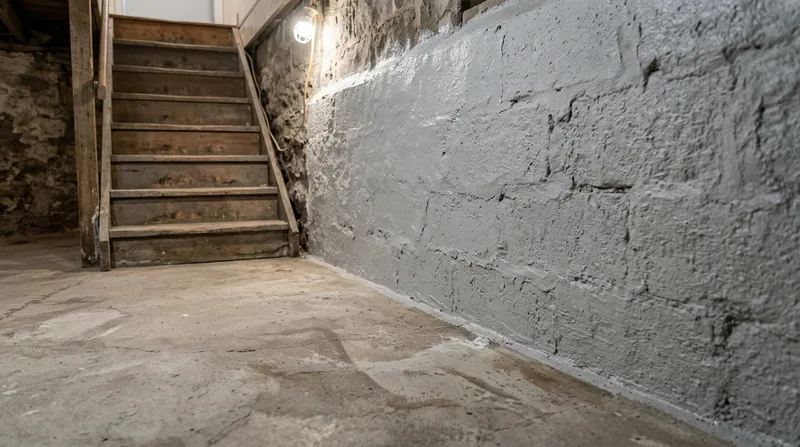
- Stone and early block walls in 1890s to 1920s homes let water seep through mortar joints and show efflorescence as white salt stains.
- Poured and block lower levels in 1950s to 1970s split-levels in Yorkville and Oriskany crack at the cove joint where the floor meets the wall.
- 1990s to 2020s subdivisions in the outer towns have poured full basements with sump systems that fail quietly when a check valve sticks.
- Grading that slopes back toward the house and short downspouts push roof water right back against the foundation.
None of these are mysteries once you know the building stock, and the inspection sorts out which one you are dealing with.
Key info: A 1918 brick two-family in Cornhill with white powder on the wall and a damp floor is usually showing capillary seepage through old mortar, not a failed footing drain. A 1965 ranch in Yorkville with water only after heavy rain is usually a hydrostatic pressure problem at the cove joint. Same symptom, different fix.
For the official word on what work needs a permit, check the City of Utica building department before any structural or drainage work begins.
How We Run the Inspection, Step by Step
We do not guess from the doorway. The inspection follows the water, from the roof line down to the footing, and it takes as long as your basement needs. You get a written summary and photos you can keep, whether or not you hire us. If the answer is a crack repair, we say so, and if the answer is an interior perimeter drain, we explain why excavation is not the better call here.
- We start outside, checking grading, downspout extensions, window wells, and any sign of settlement along the foundation.
- We walk the interior perimeter and map every crack, damp patch, and efflorescence trail on the wall.
- We test the sump pump, check the check valve and discharge line, and note whether a battery backup is in place.
- We check the floor for heaving or staining that points to water coming up rather than in.
- We photograph everything, then sit down and explain what needs fixing now, what can wait, and why.
If the inspection points to a wet basement caused by pressure at the wall, the next conversation is usually about an interior drain tile system, which we size to the basement, not to a template.
Key info: On a 1952 Cape Cod in Whitesboro with a partly finished basement, we found the sump pump running but the discharge line frozen at the wall in January. The fix was a discharge line rerouted above the frost line and a battery backup, not a new drain system. A 30-minute look saved that homeowner a five-figure excavation quote from another outfit.
Inspection Findings and What They Usually Mean
Every inspection ends with a finding, and the finding points to a method. The table below shows how we match what we see in Utica basements to the approach that actually solves it. We do not sell one method to every house.
| Approach | Description | Best for |
|---|---|---|
| Crack injection | Epoxy or polyurethane injection into ports along a poured-wall crack | A single active crack in a poured foundation, no wall movement |
| Interior perimeter drain | Drain tile along the inside footing, tied to a sump basin | Hydrostatic pressure at the cove joint, water across the whole floor |
| Exterior waterproofing | Membrane and dimple board on the outside wall, new footing drain | Stone or block walls that are failing from the outside, accessible by excavation |
| Wall stabilization | Carbon fiber straps or wall anchors on a bowing wall | Inward movement from clay pressure, before the wall cracks through |
| Sump and discharge | New sump pump, check valve, and discharge line routed to daylight | A working drain system with a failed or undersized pump |
The inspection tells us which row applies to your house, and we put that in writing.
Free Basement Inspection Cost in Utica: What to Expect
The inspection itself costs nothing, and that is not a marketing trick. We treat it as the first step of the job, because a repair sold without a look is a guess. What the inspection does is tell you what the actual repair will cost, and that number depends on the finding, not on a flat menu. A single crack injection is a small job. An interior drain tile system around a full basement is a larger one. The factors that move the number are the length of wall involved, whether the floor has to be opened, whether the sump system needs replacement, and whether a bowing wall needs stabilization.
Get two or three estimates on any significant repair, and compare what each one includes, not just the bottom line. Our full pricing overview lays out how we build a number so you can compare apples to apples.
Choosing a Waterproofing Contractor Near Utica: What to Check
A free inspection is only worth what the company behind it is worth. Before you let anyone start cutting floor or injecting a wall, check three things: licensed and insured status, references from jobs similar to yours, and a written scope that says what is and is not included. Ask whether the company specializes in below-grade work or treats waterproofing as a sideline to general foundation repair.
- Ask for a certificate of insurance and confirm it is current.
- Get two or three written estimates and compare the scope line by line.
- Ask for references from Utica or New Hartford basements with the same wall type as yours.
- Confirm who pulls the permit if the work is structural or alters drainage, because rules vary by jurisdiction.
If a company cannot answer those questions plainly, keep looking. You can reach us through our contact page to schedule the inspection.
Free Basement Inspection Near Me: What Utica Homeowners Should Know
Most calls we get start with a homeowner standing in a wet basement after a storm, or noticing a musty smell in July, or finding the sump pump dead on a Sunday. The inspection is the fastest way to sort a real problem from a cosmetic one. We serve Utica and the surrounding towns, and we answer the phone at (315) 864-5045. If you are in a 1920s foursquare in Cornhill or a 1998 colonial in New Hartford, the inspection looks different, but the goal is the same: find the water path and tell you the truth about it.
Free Basement Inspection in Utica: Pricing Guide
| Service | Price | Details |
|---|---|---|
| Free basement inspection | Free | Full walkthrough of walls, floor, cracks, sump system, grading, and gutters with photos and written findings. |
| Crack injection (single crack) | Starting at $450 | Epoxy or polyurethane injection on one poured-wall crack, priced by crack length and access. |
| Interior drain tile system | On estimate | Priced per linear foot of perimeter, plus sump basin and discharge routing; floor opening adds cost. |
| Sump pump replacement | Starting at $650 | Pump, check valve, and discharge line; battery backup and line routing add to the base price. |
| Travel | Included | In Utica and surrounding towns, no separate call-out or mileage fee for the inspection. |
| Estimate | Free | Response within 24h at (315) 864-5045, no obligation to book any work. |
Indicative pricing, the exact cost depends on square footage, finish, and site access. Free personalized estimate within 24h at (315) 864-5045.


